

The Most Expensive Financial Mistake Isn’t Spending. It’s Waiting.

WEALTH
The Most Expensive Financial Mistake Isn’t Spending. It’s Waiting.
NOVEMBER 17, 2026 • 10 MIN READ
What 5, 10 and 20 Years Can Do to the Money You Haven’t Invested Yet
The Price of Someday
Imagine discovering that one of the most expensive financial decisions of your life wasn’t something you bought. It was something you postponed. Not investing $200 a month because you wanted to earn more first. Waiting until your career felt secure. Until the children were older. Until you understood the stock market.
Meanwhile, years passed, and the money you could have invested never had the opportunity to grow. This is the hidden cost of waiting: not simply the money you didn’t save, but the potential growth that money never earned. And understanding that difference could change how you approach your financial future.
Why Time Can Be More Valuable Than the Amount You Invest
When women think about building wealth, the first question is often, “How much money do I need?” But an equally important question is, “How much time can I give my money to grow?” This is where compound growth becomes powerful. When investments generate returns, those returns can remain invested and potentially generate additional returns. Over many years, that growth can become increasingly significant.
Consider two women investing $200 monthly, assuming a hypothetical 6% annual return compounded monthly. One invests for 20 years and contributes $48,000. Her portfolio could grow to approximately $92,400. The other invests the same amount for 10 years, contributing $24,000, and could accumulate approximately $32,800.
The difference isn’t simply their contributions. It’s the additional years of potential investment growth. Markets fluctuate, returns aren’t guaranteed, and fees and taxes reduce results. But the lesson remains: starting earlier gives compounding more time to work.
What Waiting 5, 10 or 20 Years Could Actually Cost You
Let’s make the cost of delaying investing visible. Imagine you have $250 available every month and plan to invest until age 65. Assuming a hypothetical 6% annual return, compounded monthly, the difference between starting at 35 and waiting until 40 is substantial.
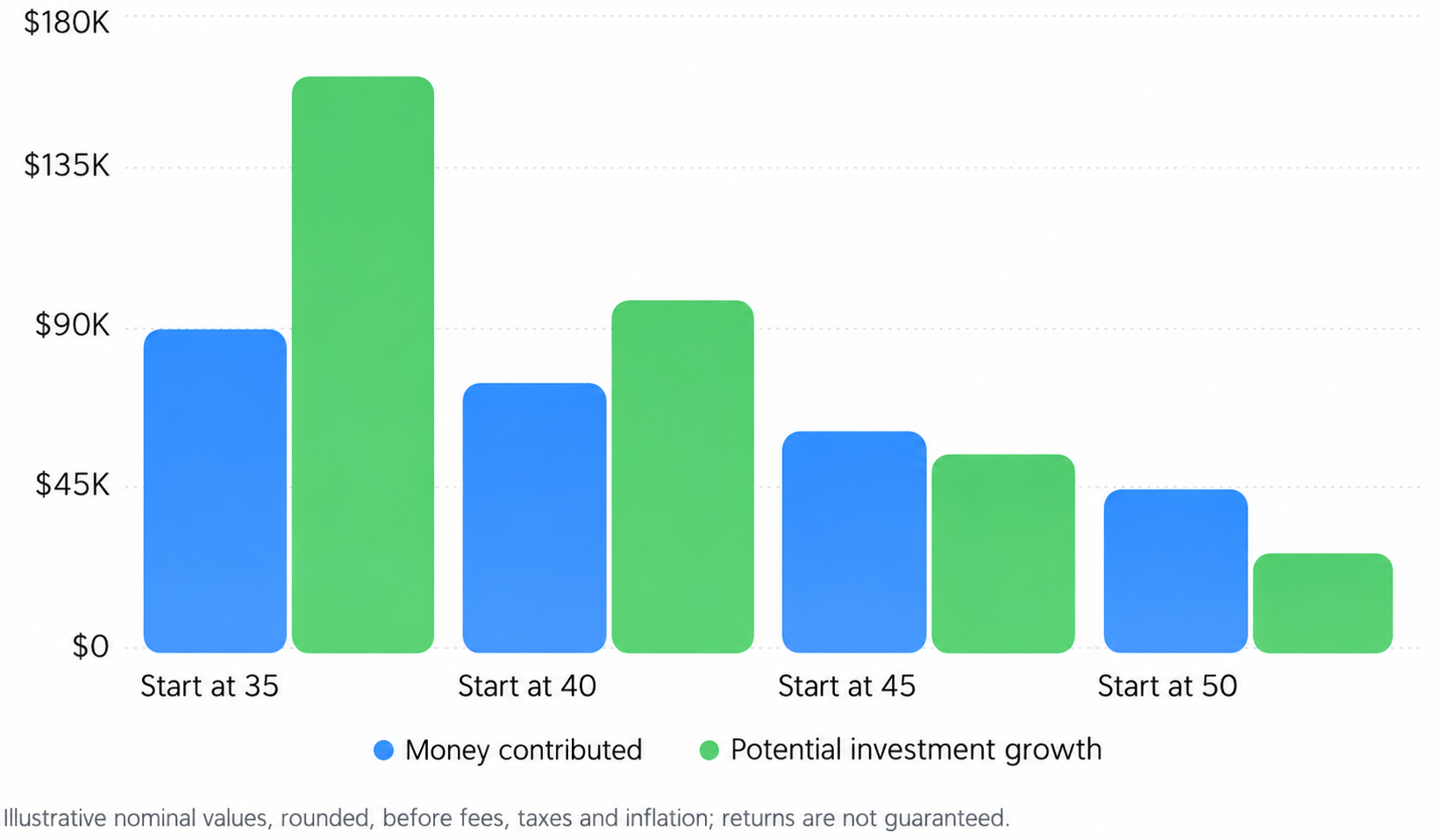
Starting at 35 could produce approximately $251,100. Waiting until 40 could reduce that to $173,200. Starting at 45 could produce $115,500, while starting at 50 could still build approximately $72,700.
These aren’t predictions. Real investments experience market volatility, and inflation affects purchasing power. But the comparison illustrates something important: postponing investing doesn’t simply delay your progress. It reduces the years available for potential compound growth.
And although earlier is advantageous, starting later can still make a meaningful difference.
Starting at 35, 40, 45, or 50: What You Can Still Do
At 35, you may have three decades until retirement. Even modest monthly investments can benefit from a long investment horizon. At 40, the priority is consistency rather than trying to compensate for every missed year. At 45, reviewing your pension, increasing contributions when affordable, and understanding your investment allocation become especially valuable. At 50, you still have opportunities to build wealth, but balancing growth with risk, liquidity, and your expected retirement date becomes increasingly important.
The biggest mistake is believing that because you didn’t start at 25, investing no longer matters. Before investing, establish an appropriate emergency fund and consider paying down expensive debt. Then explore diversified, low-cost investment funds or ETFs suited to your circumstances. Automating a manageable monthly contribution can make consistency easier.
You don’t need to recover every year you missed. You need a realistic financial strategy for the years still ahead of you.
How to Stop Waiting for the Perfect Moment to Invest
Many women postpone investing because they’re waiting for something: a higher salary, fewer expenses, greater financial knowledge, or a calmer economy. Those concerns can be reasonable. But waiting for perfect conditions can become an indefinite financial decision.
Start by calculating what you can genuinely afford to invest without compromising essential expenses or emergency savings. Perhaps it’s $50 monthly. Perhaps it’s $300. Then define your investment horizon, learn the basic risks, and compare diversified funds, fees, and available tax-advantaged accounts in your country.
Avoid investing money you’ll need soon in volatile assets. And don’t confuse getting started with making impulsive decisions.
One practical exercise: calculate the potential future value of investing $100, $200, or $300 monthly over your remaining working years. Use several return assumptions, including a low-growth scenario. The purpose isn’t to predict your future wealth. It’s to replace vague intentions with an informed, achievable plan.
You cannot invest yesterday’s money today. But you can decide what happens to the money you earn tomorrow. Financial independence isn’t built by regretting the age at which you should have started. It’s built through the decisions you make with the time, knowledge, and resources you have now.
You may not be able to give your money more years in the past. But you can stop taking years away from its future.
Editorial note: All investment calculations are illustrative, using monthly end-of-period contributions and a hypothetical 6% annual return compounded monthly. They exclude fees, taxes, and inflation. Investment returns are uncertain, and capital can lose value.
“The most expensive word in your financial vocabulary might be ‘someday.’ The most powerful one is ‘today.’”
JOIN THE NEW ME LETTER
Your next chapter starts here.
Join thousands of women becoming the highest version of themselves, inside and out.